

PeaceEye is an Austrian start-up that is advancing the frontier of geospatial risk analytics. Combining Earth Observation (EO), media and open-source intelligence with AI-driven risk models, the team delivers actionable, tailored insights to support policymakers, civil society, and private sector actors. Our mission is to empower decision-makers with holistic situational awareness and help proactively mitigate complex risks – from humanitarian crises to geopolitical instability.As a university spin-off, PeaceEye builds on deep scientific and technical expertise, fusing academic excellence with real-world humanitarian field experience.
Conflict Media Intelligence
Within the Smart connect project, we provide tailored conflict media intelligence to SISTEMA for the Sudan Nutrition Support provided for UNICEF. Specifically, we developed a conflict indicator by implementing a mediaINT data pipeline that classifies open-source news information and extracts conflict news relevant to the nutritional vulnerability in Sudan.
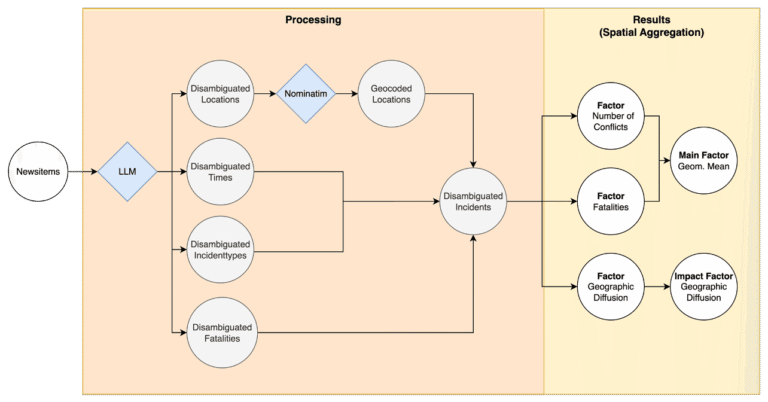
Our work involved adaptation of the existing conflict taxonomy for proprietary conflict event classification, conflict classification using AI specifically Large Language Models (LLMs) for Natural Language Processing of the News Items to extract localized conflict events relating to food security in Sudan.
Justification
Studies have found that although Food Insecurity Prediction accuracy can be as high as the 90th percentile in some cases, this can be significantly reduced in the event of unforeseen circumstances like extreme weather events, economic shocks, or conflict events (Bertetti et al. 2024). Extant research reveals that there exists a bi-directional relationship between Food Insecurity and Conflict. Most of the extreme famine-like conditions witnessed in recent history have been directly or indirectly influenced by Conflict events, e.g., Somalia, Sudan, etc. (FAO 2018, Fitzpatrick. M, Maxwell. D 2012). It is therefore necessary to consider such factors to ensure a robust index estimation process.
This informed the decision to include Conflict Event data produced by PeaceEye into the Severity Nutrition Index Calculation.
Technical Framework
Conflict event data was created to align with existing standards and best practices. Raw data from thousands of news sources were received from our partners Headline Hunters, from which context-specific (Conflict, Food Insecurity, Natural Hazards) events with relevant attributes (Date, Location, Fatalities) were extracted using our State-of-the-Art Data Extraction Pipeline.
Results
- GeoJSON files containing monthly extracted events for June to November 2025 were provided to SISTEMA for integration into the Severity Nutrition Index Calculation.
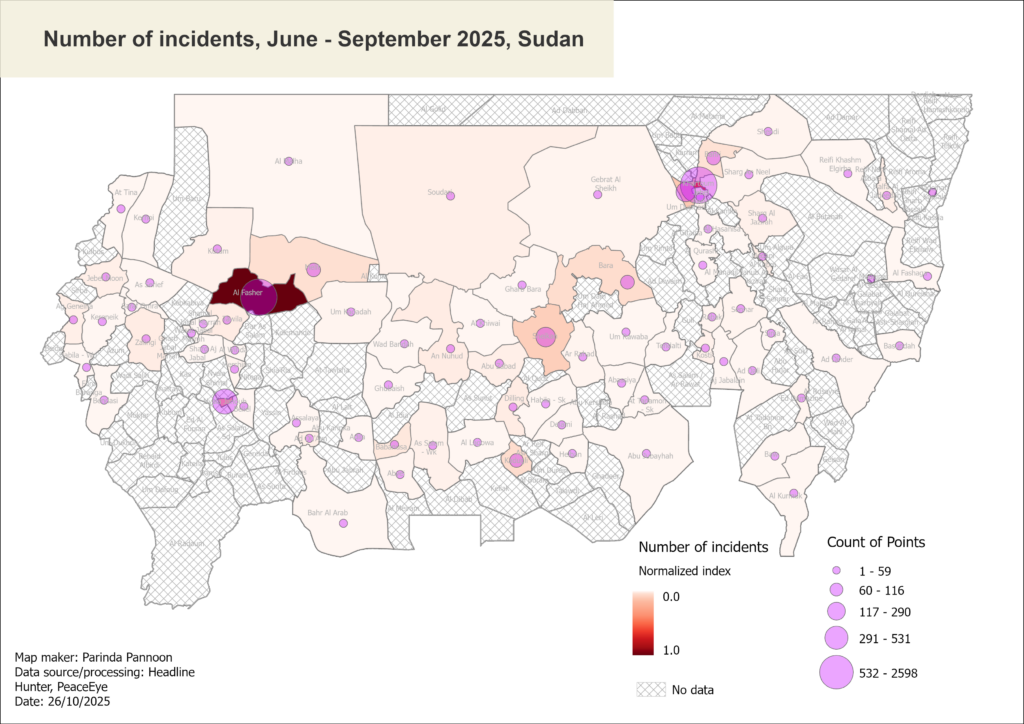
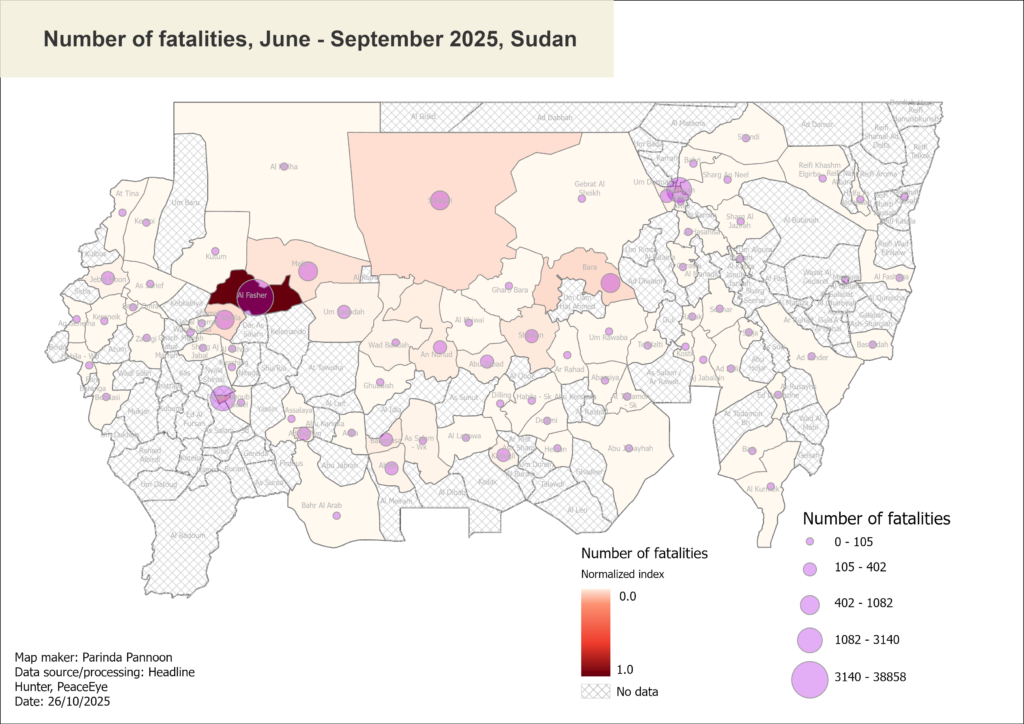
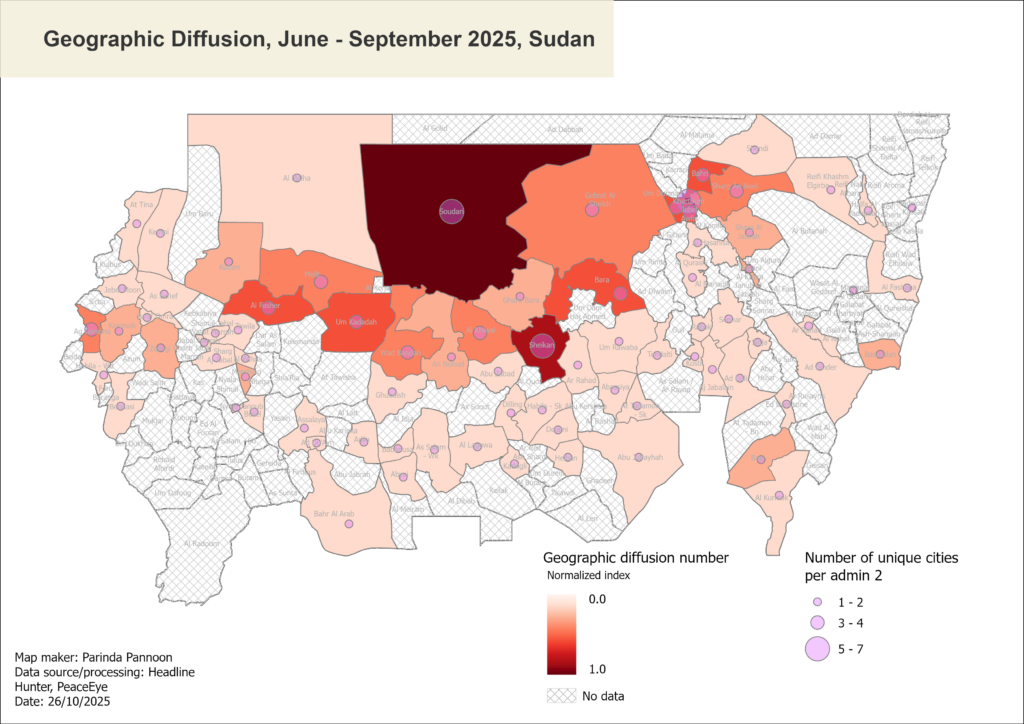
- Map Visualizations, at ADM2 level, were also created to help communicate the results, some of which are shown here.
Ethical Considerations
- Data was supplied by our partner, Headline Hunters, and collected from reputable public news sites and social media using advanced web crawlers. The data remains free from third-party manipulation, and original sources are available.
- News items were processed specifically for the Severity Nutrition Index using our proprietary data pipeline, hosted on secure servers within Europe.
- Extracted conflict data was compared with the ACLED benchmark and showed positive correlation. Full validation was not possible due to limited ground-truth data.
- Data sharing was strictly controlled and conducted through protected systems across all partners.
- Our pipeline was designed to support fair, neutral, and impartial humanitarian action, safeguarding human rights.
- Clear communication was maintained with partners and stakeholders throughout the project.
- The project was implemented in close collaboration with UNICEF, who coordinated locally with affected communities.
- Data processing remained people-focused, prioritizing the perspectives of affected individuals wherever appropriate.